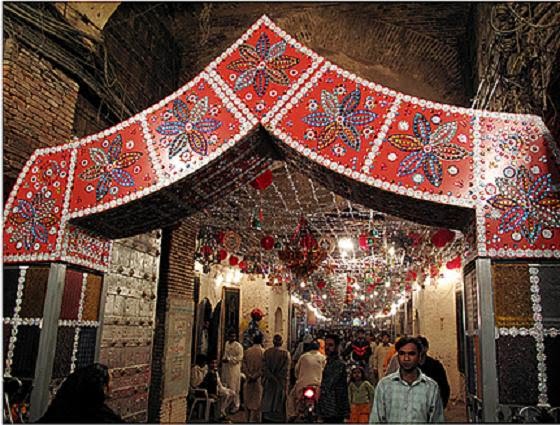
Mochi Gate Lahore. Source: Panoramio.
Monday, March 28, 2016
Week 9 Review
I absolutely LOVED the video Google Search: Reunion! What a beautiful piece. I was saddened by the news about Lahore, Pakistan and this video made me even more sad to see people who actually resided near the same park. It was incredibly touching to see the reunion of these two old friends. I highly recommend this video and intend to look for more that are possibly made by this same author.
Tech Tip: Sidebar Box
For this week's tech tip, I added an HTML/Javascript box to my sidebar as you may have noticed. I decided to call it "About My Blog" and included a brief summary that I thought may be beneficial to my blog viewers.
Wednesday, March 23, 2016
Week 9 Reading Diary: Chapter 2 - Narayan's Secret
In 7 Secrets of Hindu Calendar Art by Devdutt Pattanaik, the main idea of Chapter 2: Narayan’s Secret is that what dies is always reborn.
Lakshmi, the Goddess of wealth, nourishes mankind and is interestingly portrayed as a cow. As the cosmic cow, she embodies the entire world. Similarly, Vishnu’s turtle avatar Kurma is a cosmic turtle, who holds the entire world on his back.
Next, we learn about Hanuman and Vishnu’s companionship who team up to regain Vishnu’s lost queen, Sita. Hanuman is known as the “trouble-shooter” because his presence means that problems are also present BUT he reminds us that the mind is capable of coming up with solutions to the problems!
According to Hindu beliefs, the world began with Narayan’s awakening. Hindus also believe that if Narayan was asleep, he must have previously been awake. Therefore, his awakening was actually a rebirth of a world that had already existed. This cyclical pattern is characteristic of Hinduism, which is one of the few religions that roots itself in rebirth. To name a few, the Greek, Christian, or Muslim faiths only believe that there is one life. This is why Hindus feel less rushed to live a heroic or extraordinary life – because it is only one of many lives to come.
A lotus, which Brahma is seated on, sprouts out of Narayan’s belly button. This leads to a question similar to that of the chicken and the egg, did Narayan create Brahma or did Brahma create Narayan?
Creation depicted as Narayan with Brahma on lotus and Lakshmi at feet.
Source: Prezi.
Source: Prezi.
Lakshmi, the Goddess of wealth, nourishes mankind and is interestingly portrayed as a cow. As the cosmic cow, she embodies the entire world. Similarly, Vishnu’s turtle avatar Kurma is a cosmic turtle, who holds the entire world on his back.
Next, we learn about Hanuman and Vishnu’s companionship who team up to regain Vishnu’s lost queen, Sita. Hanuman is known as the “trouble-shooter” because his presence means that problems are also present BUT he reminds us that the mind is capable of coming up with solutions to the problems!
Interestingly, creation is often referred to as the result of awareness.
Week 9 Reading Diary: Chapter 1 - Ganesha's Secret
I would highly recommend watching the 7 Secrets of Hindu Calendar Art by Devdutt Pattanaik if you have any interest in learning more about Hinduism. The main idea of Chapter 1: Ganesha’s Secret is that different people see god differently.
Shiva is the god of the mountains while Parvati, his wife, is a mountain princess.
Shiva is depicted with a river flowing out of his forehead. Their two children are Ganesha and Kartikeya. As you can see below, Ganesha is portrayed with a head of an elephant.
I really enjoyed the observation that although this scene may seem strange to us, it is not out of the ordinary to Hindus because they are taught to accept them without feeling like they need rationale. Similarly, especially in the West, Christians are taught to accept the Lord’s word without question. In Hinduism, the divine can reside in anything from plants to animals to human beings. I love this idea! If the divine resides in nearly anything and everything, it teaches us to respect the natural world.
I was blown away by the story of Ganesha and Kartikeya who raced around the world three times. Ganesha ran around his parents three times; Kartikeya was confused why his brother was doing this and Ganesha explained that his parents are his world. He then proposes the question, “Which one matters more?” This is subjective to an individuals’ own beliefs – is his family or the entire world more important?
These gods are so beautiful and this video does a great job explaining the importance of each. When Shiva closes his eyes, the world ceases; this is why he is referred to as “the destroyer” and is known as God to many. Princess Parvati is master of emotions, how feminine and intriguing is that?
Because male is incomplete without female according to Hinduism, there is an invisible female force, or Goddess, called Saraswati or Veda-Mata, which means mother of the Vedas. This is why Brahma did not compose the Vedas but instead received the Vedas, because no man can create anything without woman – not even God. I thought this was wonderful that Hinduism promotes such pure femininity.
Brahma is portrayed with four heads, which represent the four expressions of the Veda, or the four goals of life:
From what I have gathered, Hindus intentionally live well-balanced lives. I think we could all learn a lot from them whether we choose to practice Hinduism or not.
Shiva is the god of the mountains while Parvati, his wife, is a mountain princess.
Shiva is depicted with a river flowing out of his forehead. Their two children are Ganesha and Kartikeya. As you can see below, Ganesha is portrayed with a head of an elephant.
Ganesha. Source: Flickr.
I really enjoyed the observation that although this scene may seem strange to us, it is not out of the ordinary to Hindus because they are taught to accept them without feeling like they need rationale. Similarly, especially in the West, Christians are taught to accept the Lord’s word without question. In Hinduism, the divine can reside in anything from plants to animals to human beings. I love this idea! If the divine resides in nearly anything and everything, it teaches us to respect the natural world.
I was blown away by the story of Ganesha and Kartikeya who raced around the world three times. Ganesha ran around his parents three times; Kartikeya was confused why his brother was doing this and Ganesha explained that his parents are his world. He then proposes the question, “Which one matters more?” This is subjective to an individuals’ own beliefs – is his family or the entire world more important?
These gods are so beautiful and this video does a great job explaining the importance of each. When Shiva closes his eyes, the world ceases; this is why he is referred to as “the destroyer” and is known as God to many. Princess Parvati is master of emotions, how feminine and intriguing is that?
Because male is incomplete without female according to Hinduism, there is an invisible female force, or Goddess, called Saraswati or Veda-Mata, which means mother of the Vedas. This is why Brahma did not compose the Vedas but instead received the Vedas, because no man can create anything without woman – not even God. I thought this was wonderful that Hinduism promotes such pure femininity.
Brahma is portrayed with four heads, which represent the four expressions of the Veda, or the four goals of life:
- Dharma – righteous conduct
- Artha – economic activity
- Karma – pleasurable pursuits
- Moksha – spiritual practices
From what I have gathered, Hindus intentionally live well-balanced lives. I think we could all learn a lot from them whether we choose to practice Hinduism or not.
Sunday, March 20, 2016
Week 8 Review: Spring Break
Spring Break flew by as usual and as usual I am completing this week's assignments on Sunday night... But I am happy to feel rested and somewhat caught up and ready to take on this week! I spent my spring break in Cabo San Lucas, Mexico. Where did you spend yours? I would love to know in the comments below!
This week I really enjoyed checking out the Tale of the Traveling Cat. The picture really caught my eye - I just love this cat with glasses, and what a neat blog!

Thursday, March 10, 2016
Tech Tip: Embed Tweet
For this week's Tech Tip, I chose to embed a tweet and Wow, I am so impressed! This is so cool. I chose this tweet posted by OU Daily and also re-tweeted by Professor Laura Gibbs because I thought it was very powerful and an impressive display on the part of OU's students.
"There’s still a lot of work to be done."@OU_Unheard recalls the SAE incident: https://t.co/KY41sOu4p3 pic.twitter.com/Nx5i4ZnJPg— OU Daily (@OUDaily) March 7, 2016
Epics of India Reading Plan
During Week 9 I would like to finally watch Nina Paley's "Sita Sings the Blues." I am also very interested in watching the film series "Seven Secrets of Hindu Calendar Art - Gods and Goddesses."
During Week 10 I want to read the Buddhist Jataka Tales. I have always been interested in Buddhist ideas and feel that they really resonate with me. I also think that they could be beneficial to my storybook theme of karma, as this is a core belief in Buddhism.
I am also open to reading suggestions, specifically those that may help me write my Storybook (that have to do with turtles, sea-life, and/or karma).
During Week 10 I want to read the Buddhist Jataka Tales. I have always been interested in Buddhist ideas and feel that they really resonate with me. I also think that they could be beneficial to my storybook theme of karma, as this is a core belief in Buddhism.
I am also open to reading suggestions, specifically those that may help me write my Storybook (that have to do with turtles, sea-life, and/or karma).
Bhavacakra. Source: Wikipedia.
This image depicts the samsara, an important symbol to Buddhists. Samsara means cyclic existence or wheel of life, and can be compared to the idea of karma. This is also an important concept in yoga.
Subscribe to:
Posts (Atom)


